
Living with visa uncertainty
1. Visa uncertainty hinders our ability to work and contribute economically.
Although Ukrainians under the HfU, UPE and UFS schemes have full permission to work, many employers are reluctant to offer permanent contracts or internships to individuals with temporary leave to remain.
Highly qualified professionals are often unable to have their Ukrainian degrees recognised without requalification or completing further training placements. However, they are frequently refused access to such programmes because the validity of their visas may not cover the full duration of the course or training.
As a result, many Ukrainians are effectively prevented from securing skilled employment or undertaking the necessary professional training due to visa limitations, while at the same time potentially falling within the economic criteria of the proposed “Earned Settlement” model — criteria they are structurally unable to meet.
This places individuals at a significant disadvantage and limits their ability to contribute fully to the UK economy.
Olia, Kyiv, 35 years old, has been in Britain since 2022 and has a child born in 2012.
My child and I left Kyiv after the Russian army hit the TV tower near our house on 1 March 2022, killing people. Even after arriving in the United Kingdom, we believed that the war would end soon and that our son would start school at home in September. When it became clear that this was not the case, I started looking for a job.
In Ukraine, I worked as a logistics manager, had a good salary and an accounting degree — I hoped to find the same job in Britain.
I started applying for relevant vacancies and received only silence in response. At first, I blamed it on my lack of language skills, even though I used English at my job in Ukraine. I started taking courses and studying the language day and night, while continuing to send out my CV. The situation did not change — I did not even receive rejections, mostly just silence.
When it became clear that I would not be able to find a job in logistics quickly, I started applying for almost all vacancies in all towns near my new home. I applied for jobs as a librarian, an assistant accountant, and eventually even responded to an advertisement for a waitress in a restaurant. I felt uncomfortable doing nothing. I didn’t want to be in a position where I had to ask for government assistance. That’s not my story.
Finally, I found a part-time job as an assistant accountant at a charity organisation. The salary was modest, but it was an important experience and added to my CV.

At the same time, I was taking accounting courses and looking for a full-time job as an accountant. Finally, I successfully passed two rounds of interviews for the position of Senior Accounts Assistant at a private organisation. They were looking for someone for the long term — the senior manager wanted to train her replacement, and we liked each other. When it came to my documents, they were very confused and ultimately rejected me with the wording ‘we have a little concern with the visa situation.’ I can understand them. Who would hire someone with an uncertain visa status?
To be honest, after this situation, I was in real despair — because the problem was no longer my English or qualifications, but my visa situation, over which I have no control. This situation can break even an adult — let alone young Ukrainians who find themselves in the same situation after graduation.
As a result, I am now continuing to work for a charity and studying for a master’s degree — I work full-time three days a week and study at university two days a week. I went there hoping that local education would improve my chances of finding a job. My son’s and my visa expires on 30 October 2026 — we don’t know what will happen next.
Of course, all this has a very negative impact on my psychological state. In addition to studying, working, looking for a new job, and raising a teenager on my own, I am under daily pressure from uncertainty: will our visas be extended for another 24 months? I won’t even mention how this situation affects my school-age son.
It is worth noting that the visa situation directly affects not only the possibility of employment, but also the possibility of renting accommodation. My lease expires along with my visa — in October 2026. Who would agree to a long-term lease for someone without a visa? It’s a vicious circle that even someone as active as me finds difficult to endure.
We would be grateful if, as an interim solution, the Home Office would post an official announcement on its website regarding the automatic extension of visas for Ukrainians for the next 24 months.
2. Hostages of Uncertainty: Why UK Visa Policy is Jeopardising the Future of Ukrainian Students

Marina Murlyan, a doctoral researcher and mother of two, speaks out about the ‘glass ceiling’ facing Ukrainian youth, the barriers within higher education, and the mental health crisis triggered by bureaucratic limbo.
When Marina Murlyan arrived in the UK from Dnipro in 2022, she hoped that education would provide her children and herself with a foundation for integration and stability. Today, however, as a PhD candidate at a British university, she observes a sobering reality: the temporary nature of Ukrainian visa schemes is becoming an insurmountable barrier for talented young people.
In a recent interview, Marina outlined three critical areas where the British system, despite its initial goodwill, is currently failing Ukrainian students.
1. The Educational Deadlock: “Home Office Guidelines are Not Enough”
According to Marina, many Ukrainian students are facing rejections at the admissions stage. The reason is rarely academic merit, instead, it is their visa expiry date.
“Friends of my son and my own goddaughter have been denied university places because they couldn’t guarantee their visa would cover the full duration of their course. Even official guidance from the Home Office is merely advisory, and unfortunately, many universities simply choose to ignore it,” Marina explains.
Marina herself is currently in a state of “legal limbo.” Her visa expires in November, yet her university requires confirmation of her status for the upcoming academic year by September. Under current rules, she can only apply for a visa extension four weeks before her current one expires. This creates an absurd situation where a successful researcher’s future depends entirely on whether the university administration is willing to “turn a blind eye” to a temporary lack of paperwork.
2. The Job Market: A Reluctance to Invest in “Temporary” Talent
The problem is even more acute regarding employment, particularly for placement years and internships – crucial components of the British degree system.
- Status-based Rejections: Private companies are often reluctant to offer placements to Ukrainians, fearing the student won’t be able to continue working after their current visa expires.
- Lost Opportunities: Highly motivated students from top-tier universities are losing out on competitive schemes, not due to a lack of skill, but due to administrative uncertainty. Employers are hesitant to invest in individuals whose right to remain is only guaranteed for another year.
3. The Psychological Toll of Limbo
Perhaps the most devastating consequence is the impact on mental health. Marina describes the state of the youth as being “hostages to their situation.”
“In the last six months, my son has been rushed to A&E four times due to severe panic attacks – twice from work and once from university. The psyche of these children, who have already survived the trauma of war, simply cannot withstand the constant pressure of this unknown future.”
The crisis is exacerbated by a lack of accessible support. The NHS mental health services are overstretched, and private therapy – £45-60 per hour – is a luxury far beyond the reach of a typical student. Marina estimates that roughly 80% of Ukrainian youth in the UK are currently in need of professional psychological support.
Marina’s Proposals: A Path Forward
As both a mother and an academic, Marina proposes systemic changes to resolve the crisis:
- Visa Stability: Issue permits for a standard 36-month period to cover a full undergraduate or postgraduate cycle.
- Earlier Extension Windows: Allow students to apply for visa extensions at least six months before expiry, rather than 28 days. This would provide the necessary certainty for both universities and HR departments.
- A Joint Strategy with Ukraine: For those intending to return home eventually, establish integrated online programmes in collaboration with the Ukrainian government.
“Right now, I’m trying to live one day at a time – just going with the flow because so much is out of our control. But our children deserve more than just being ‘allowed to finish their studies.’ They deserve the right to plan their lives.”
3. Negative impact on the psychological and physical development of young children
Many Ukrainian children arrived in the United Kingdom between the ages of two and five and have now spent the majority of their lives here. They speak fluent English, attend British schools, have British friends, and often have little or no memory of life before the war; others, however, remember shelling, forced displacement, and loss.
Yet their sense of stability depends on temporary visas with no clear long-term perspective. Under Article 3 of the UN Convention on the Rights of the Child, the best interests of the child must be a primary consideration in all decisions affecting them. Ongoing uncertainty places unnecessary strain on their development and on their parents — often mothers raising children alone while striving to maintain emotional stability within the family under exceptionally challenging circumstances.
Tetiana Pantielieieva, 36 yo, from Berdiansk, living in the UK since June 2022, mother of a child (born in 2015)
My son has special educational needs. In Ukraine he received some support, but many of his needs were never fully met. During the winter of 2021–2022, his school was receiving fake bomb threats almost every day. Lessons were constantly interrupted, and on the eve of the full‑scale invasion he was essentially studying at home.
When we arrived in the UK, my son barely spoke any English. But we were incredibly fortunate with his primary school. It is a school that truly understands children with special educational needs, and they treated my son with patience, dignity, and genuine care. They recognised his challenges, supported him every step of the way, and helped him grow in ways I could only hope for.
Their support was so transformative that he passed the 11+ exam and earned a place at a grammar school — one of the most competitive academic routes in the UK. I believe my son is a hero. To arrive in a new country, start with almost no English, and within four years pass one of the hardest tests for children his age — that is an extraordinary achievement.
Outside school, Sam does martial arts, plays the viola and piano, performs in a string orchestra, and sings in a choir. This May, he will travel with the Chiltern Music Academy to perform on the Isle of Wight. He finally has a calm, stable life. I can see a bright future for him here. He tells me he loves his school, he loves his life here, and he wants to stay in the UK close to his family and his support network. It still amazes me that after just a couple of years, English has become the language we use most naturally at home.
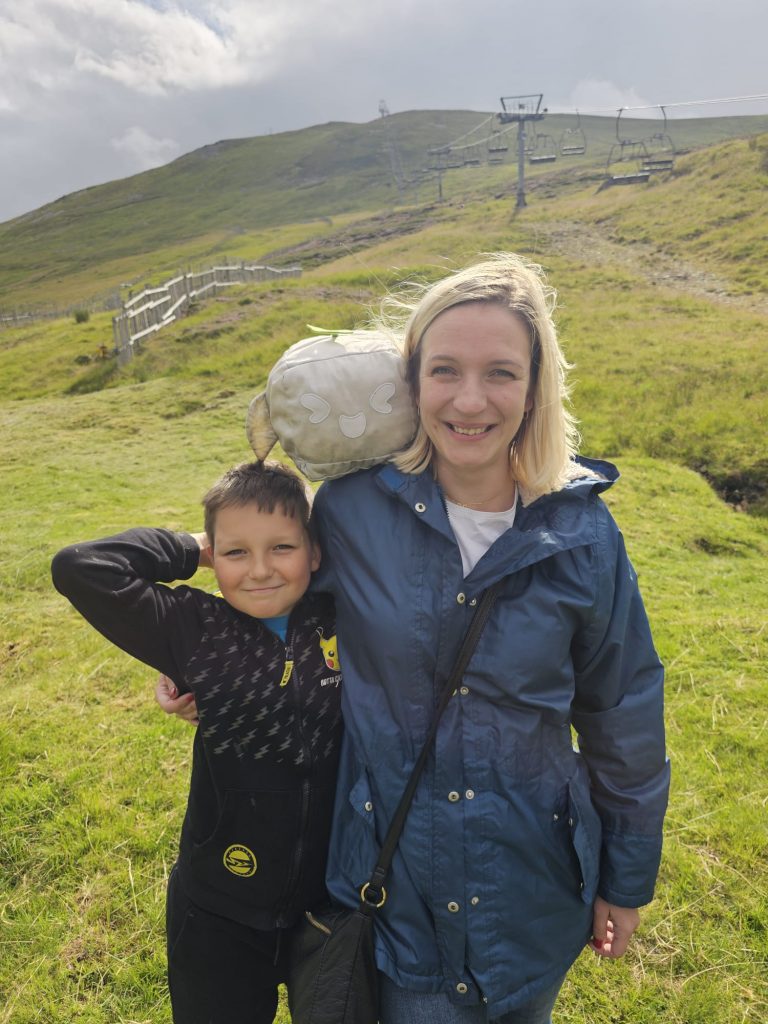
We have truly built a life here. Sam has his school, we have stable housing, and we are supported by the Hilltops Ukrainian Support Community. I was able to bring my mother and stepfather from the occupied territories, which gave us a sense of safety and unity again. I work for Buckinghamshire Council and now have a permanent contract as a Housing Advice Officer. Sam and I have our routines — something that is essential for his wellbeing. Predictability helps him feel safe, and any disruption to his routine can have a serious impact on his mental health.
We have nowhere to return to in Ukraine. We fled from the occupied part of the Zaporizhzhia region. Given the current situation, the best way for me to support Ukraine is from here, rather than taking a child with special educational needs back to a country recovering from war, where rebuilding infrastructure will understandably be the main priority.
I would be deeply grateful if the UK government could consider the years Ukrainians have already spent here under the Homes for Ukraine scheme, and provide clearer guidance on how this time could count towards any future settled status. Ukrainians in the UK work hard, pay taxes, support our families back home, and follow UK laws. We contribute in every way we can.
Most Ukrainian families who arrived under the various Ukrainian schemes are mothers with children. For many of us, there is simply no realistic immigration route to remain long‑term. A Skilled Worker Visa requiring a minimum salary of £42,000 a year is out of reach for an ordinary mother. Many do not yet have the level of English required for such roles. Other visa routes are either unsuitable or impossible for us to access.
This uncertainty is extremely difficult for my son. It affects his sense of safety and his mental wellbeing. He keeps asking me: “Mum, please do something so we can stay here.”
4. Threat of permanent separation from own children
Vitaliia, 47, from Kyiv, living in the UK since June 2022, mother of two sons (born in 2008 and 2019).
In my case, short-term visas are a direct threat of permanent separation from my own children.
We moved to the UK with my two sons in June 2022, but after just one year, my family was torn apart twice: first through a divorce from my husband, and subsequently by the forced separation from my children. It has been a double blow — losing the support of a partner while simultaneously losing the ability to be with my children every day.
My eldest son is an academically gifted student who previously attended a specialised physics and mathematics lyceum in Kyiv. After moving, we realised that the curriculum of the local mainstream school did not fully meet his educational needs. He missed out on a place at a Grammar School by only five points – an exceptionally high result for a child who had only just integrated into a new environment. To maintain his academic momentum and continue high-level studies, we made the conscious, though heartbreaking for me as a mother, decision to return to his lyceum. He now lives between our home in Ukraine and Germany, where his father resides.
The situation with my youngest son has been the most painful. He was only three years old when we arrived due to the war. In Britain, childcare provision (nursery) for this age group is often limited to just three hours a day – nowhere near enough to allow me to adapt to a competitive job
market and full time position. Furthermore, my son began to fall ill frequently, and we struggled to access the necessary medical treatment here. Consequently, I had to make the agonising decision to send him back to Kyiv to recover and to give myself the chance to find employment. From the very beginning, I have rented housing at my own expense, and I needed to earn enough to sustain us.
I managed to secure my first role at a local Council, but it was a nine-month contract that was not extended due to departmental restructuring. Since September 2025, I have been looking for work as a Project Support – so far, without success.
The problem is that when you tell an employer your visa expires in February 2027 – the end date of my current leave to remain – they immediately lose interest. No amount of explaining the government’s promised 24-month extension for Ukrainians seems to work. Private employers are often unaware of these policies and show little interest in learning about them.
A short-term visa is like a locked door. You knock constantly, but you cannot enter. We are deemed “good enough” to be here, yet qualified positions remain closed to us. This is not just a job rejection; it is a practical ban on our professions.
As a result, I am forced to live apart from my children because I cannot secure a stable employment contract that would serve as the foundation for our life together here. Every month, as I pay my rent, I question if I am doing the right thing. I am trapped in a situation where I must either be with my youngest child in danger – in Kyiv – or struggle to secure a future for him in the UK. This is a profound and difficult choice that I live with every day.
Furthermore, my children’s visas also expire in February 2027. Since they are not currently residing in the UK, they may not qualify for the 24-month extension, which would mean the forced dissolution of our family. In my case, short-term visas are not a mere inconvenience; they are the primary barrier to my family’s reunification.
Living in this situation is incredibly difficult; speaking about it even more so. However, I hope that sharing this story helps to highlight the real pain of real people and serves as a compelling argument for extending the duration of visas for Ukrainians.